
Phones: Then vs Now
The Digital Revolution
Listen to this episode
Phones: Then vs Now
8 parts · Tap play to start
Uses a natural English voice available through your browser or device. Article text is not uploaded to NVR Nexus.
Mobile phones evolved through many overlapping breakthroughs rather than one sudden invention. Early analog handsets made calls portable, digital networks added messaging and better capacity, feature phones brought cameras and mobile data to wider audiences, and modern smartphones combined touch interfaces, app ecosystems, broadband, sensors and powerful computing. Today's phones are connected platforms for communication, photography, navigation, payments, work and entertainment—and their next phase is increasingly shaped by on-device and cloud-based artificial intelligence.
Evolution Timeline
The Journey Through Time
1973–1983
Handheld Cellular Becomes Real
Motorola demonstrates a handheld cellular prototype in 1973, and the DynaTAC 8000X receives U.S. approval in 1983.
1990s
Digital Networks and Mass Adoption
GSM and other 2G systems improve capacity, enable SMS, and support smaller, longer-lasting phones for a much wider audience.
Early 2000s
Feature Phones Converge
Color screens, cameras, music, games, Bluetooth and limited web access turn phones into multipurpose personal devices.
2007–2008
Touchscreen App Platforms
The iPhone popularizes a large multi-touch interface, while the App Store and the first Android devices help establish modern mobile software ecosystems.
2010s
Mobile Broadband Becomes Normal
4G, better cameras, GPS, cloud services and mature app stores make the smartphone a primary computing device for many people.
2020s
5G and AI-Assisted Phones
Modern phones combine faster networks with specialized processors for computational photography, speech, translation and generative AI features.
Then vs Now
Technology Transformation
Then
- —Analog voice as the primary function
- —Large body and external antenna
- —Short active-call battery life
- —Small address book and few controls
- —Limited coverage and expensive service
- —Hardware changed mainly by replacing the phone
Now
- +Voice, messaging, apps and broadband data
- +Touch display with cameras and many sensors
- +All-day mixed use on many devices
- +Biometrics, maps, payments and cloud services
- +Wi-Fi, 4G or 5G with broad but uneven coverage
- +Features can change through apps and software updates
One Device, Many Histories
A smartphone combines several once-separate product categories: telephone, camera, music player, map, game console, payment terminal, authenticator and networked computer. Its history therefore belongs to telecommunications, computing, media and software—not just telephone design.
The Network Matters
A powerful handset is only one part of the experience. Radio coverage, spectrum, network capacity, Wi-Fi, cloud infrastructure and software support determine which features work reliably in a particular place.
Featured Quote
The biggest change was not only making the phone smaller—it was turning the phone into a programmable platform.
NVR Nexus
Featured Quote
Each mobile generation changed what a phone could carry: first voice, then messages, broadband data, cloud services and increasingly intelligent software.
NVR Nexus
From Cellular Experiment to Brick Phone
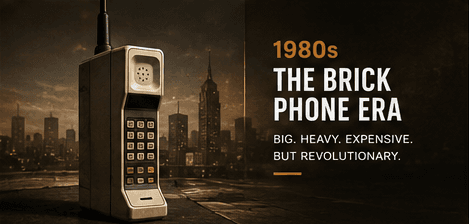
Portable voice communication existed before modern cellular service, but early car phones and radio-telephone systems were bulky, expensive and limited in capacity. Cellular architecture changed the model by dividing a coverage area into cells and allowing calls to move between radio sites as a user travelled.
Motorola publicly demonstrated a working handheld cellular phone prototype in New York City in 1973. Ten years later, the DynaTAC 8000X received approval from the U.S. Federal Communications Commission. The commercial handset weighed about 28 ounces, or 794 grams, and became an enduring symbol of first-generation mobile technology.
These early handheld phones were designed primarily for voice. They did not offer messaging, web browsing, downloadable apps or integrated cameras. The handset, charging equipment and service could cost far beyond what most consumers could justify, while network coverage was concentrated in selected markets.
Battery capacity and radio efficiency also imposed sharp limits. Active call time was short, charging was slow, and the physical antenna and electronics required a large enclosure. The size was not simply a design preference; it reflected the batteries, radio components and manufacturing capabilities available at the time.
First-generation cellular networks transmitted voice using analog radio. Compared with later digital networks, they supported fewer users per unit of spectrum and offered weaker security. Even so, the ability to make a call while moving—without relying on a fixed line—was transformative.
The brick-phone era established the basic relationship that still defines mobile service: a personal device connects by radio to a network of base stations, and the network authenticates, routes and hands off the communication. Nearly every later improvement made that system smaller, more efficient, more capable or easier to use.
Digital Networks and the Feature-Phone Boom
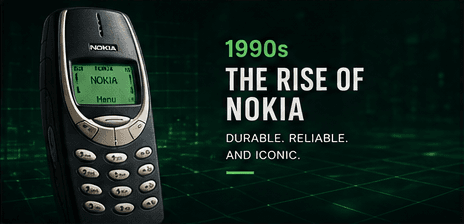
The 1990s brought the transition from analog cellular systems to digital networks such as GSM. Digitizing voice improved spectrum efficiency and helped networks serve more subscribers. It also supported services that would reshape communication, most notably SMS text messaging.
Nokia became one of the defining companies of this period. The first official GSM call was made in 1991 using Nokia equipment, and by 1998 Nokia was the world's leading mobile-phone manufacturer. Its success came from more than one famous model: the company offered devices across price ranges and markets while making menus, keypads and everyday operation approachable.
Phones became smaller as chips, batteries, displays and radio components improved. Many feature phones offered long standby times because their screens, processors and software demanded far less energy than today's large touch devices. Replaceable batteries and durable plastic bodies also made them practical for years of daily use.
Text messaging introduced a different social rhythm from voice calls. A short message could be composed quietly, sent asynchronously and stored for later. Numeric keypads produced their own shorthand and typing habits, while contact lists and call logs made the phone a more personal information device.
Games and customization mattered too. Titles such as Snake, downloadable ringtones, interchangeable covers and wallpapers made phones feel individual rather than purely functional. These features seem simple now, but they helped turn mobile devices into personal objects people carried everywhere.
The feature-phone boom was not uniform across the world. Network standards, prepaid plans, handset prices, language support and local coverage influenced adoption. In many regions, affordable feature phones continued expanding access long after high-end smartphones appeared.
Cameras, Music and the Era of Convergence
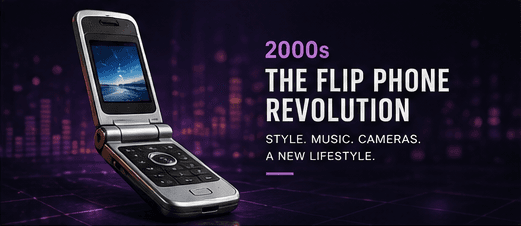
During the early and mid-2000s, manufacturers experimented with many shapes: flip phones, sliders, candy-bar phones, devices with full keyboards and early touchscreen models. Design became a visible part of personal identity, but the deeper change was digital convergence—the phone steadily absorbed functions previously handled by separate products.
Color screens, polyphonic audio, cameras, Bluetooth, memory cards and music playback moved into mainstream devices. A person could take a photo, send it in a message, transfer a file wirelessly or listen to stored music without carrying several gadgets.
Mobile internet existed, but the experience was constrained by small screens, slow networks, limited browsers and carrier-controlled services. Technologies such as GPRS, EDGE and 3G progressively made data more useful. Email-focused smartphones from BlackBerry, Symbian devices from Nokia and touchscreen or stylus-based devices showed that a phone could already be a serious computing tool before 2007.
Camera phones changed photography by making the camera continually available and connected. Early images were modest by current standards, yet the ability to capture and send a moment immediately mattered more than perfect resolution. This laid the social and technical foundation for later visual messaging and mobile social media.
The period also revealed a lasting challenge: adding more features could make software fragmented and difficult to update. Different screen sizes, operating systems, carrier requirements and input methods complicated development. The industry had many capable devices but lacked a single interaction model that ordinary users and developers could rely on across a broad software ecosystem.
By the middle of the decade, the pieces of the modern smartphone were visible—cameras, mobile data, browsers, downloadable software, location services and media playback. The next shift would reorganize those pieces around touch and apps.
Touchscreens, App Stores and the Platform Shift
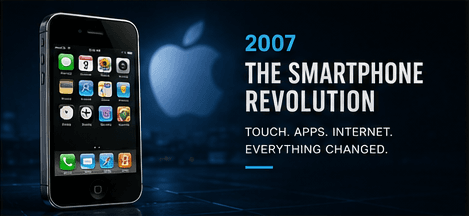
Apple introduced the iPhone in January 2007 and released it in the United States that June. It combined a phone, media player and internet device around a large multi-touch display designed for finger input. Smartphones had existed earlier, but the iPhone made direct touch interaction, a capable browser and an integrated consumer experience central to the category.
The original iPhone did not yet have today's App Store. Apple launched the store in July 2008, giving developers a centralized way to distribute native software and users a simple way to discover, buy and update it. Software could now add entirely new purposes to a phone after purchase.
Google released Android as an open-source mobile platform, and the first commercial Android device arrived in 2008. Android's availability to many manufacturers created a wide range of devices, prices and designs. Competition between platforms and manufacturers accelerated improvements in displays, processors, cameras, batteries and mobile software.
The phone became a platform rather than a mostly fixed product. Maps could use GPS, transport apps could combine location and payments, messaging apps could send media over data networks, and banks could place services behind an authenticated mobile interface. Sensors such as accelerometers, gyroscopes and proximity sensors gave software awareness of motion and context.
App ecosystems also changed the economics of software. Independent developers and large companies could distribute services directly to a global audience, while platform owners set technical rules, review policies and payment systems. This created opportunity but also concentrated influence over which apps could reach users and on what terms.
As smartphones grew more capable, they displaced or reduced demand for many standalone consumer devices. The transition was not immediate or universal, but cameras, music players, GPS navigators, voice recorders and handheld game systems increasingly became functions inside one pocket computer.
The 5G and AI-Assisted Smartphone
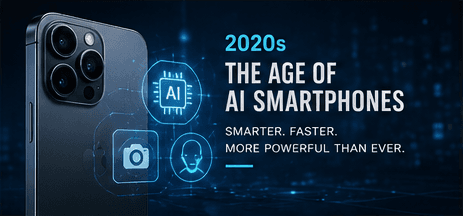
Modern smartphones combine multi-core processors, graphics hardware, image-signal processors and specialized neural-processing units. They connect through Wi-Fi and cellular networks, including 4G and 5G, while integrating cameras, microphones, satellite-positioning receivers, secure hardware, biometric sensors and short-range radios.
Artificial intelligence is not one feature or one assistant. Machine-learning models can help a camera detect scenes, combine exposures, reduce noise and isolate a subject. Other models support speech recognition, translation, predictive text, accessibility, spam detection, search and battery management.
Some AI processing happens on the device. Local processing can reduce delay, work without a connection and keep selected data from being sent to a server. It is also constrained by battery power, memory, heat and the capability of the phone's chips. Cloud processing can run larger systems but requires a network connection and introduces different privacy, cost and latency considerations. Many services use both.
Generative AI has added new forms of assistance, including summarization, text rewriting, image editing and conversational interfaces. Results can still be incorrect, incomplete or misleading, so these features need clear controls and user judgment—especially for health, finance, identity and other consequential tasks.
The network has evolved alongside the handset. 4G made all-IP mobile broadband central to daily use; 5G can add capacity, lower-latency modes and new deployment options. A 5G symbol does not guarantee one level of performance, however. Spectrum, distance, building materials, congestion, carrier configuration and backhaul all affect the experience.
Today's phone is therefore a system of systems. Hardware in the hand, carrier infrastructure, Wi-Fi, cloud platforms, app stores, identity providers and software support all contribute to whether a feature remains useful and secure over time.
What Could Come After Today's Smartphone?
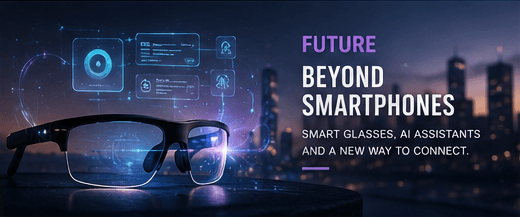
The next stage of mobile computing may not be one dramatic replacement for the rectangular touchscreen. It may be a gradual expansion of the devices and services that work around it.
Foldable screens can give a pocket device more display area, while watches and earbuds handle quick interactions without opening a phone. Smart glasses and spatial-computing systems may move navigation, translation or notifications into a user's field of view. Satellite connectivity can extend selected messaging or emergency features beyond terrestrial coverage, although capability and availability vary.
Artificial intelligence may make interfaces more conversational and proactive. A useful assistant could understand a request, work across permitted apps and complete several steps. That direction also raises difficult questions about permission, verification, privacy and responsibility when software acts on a person's behalf.
Battery chemistry, efficient chips, repairability and longer software support may be as important as novel form factors. Phones consume materials and energy across manufacturing, transport, use and disposal. Devices that last longer, receive security updates and can be repaired reduce the pressure to replace functional hardware.
The future will also be shaped by policy and market structure. App distribution rules, platform competition, data protection, radio spectrum, accessibility standards and the right to repair influence what manufacturers can build and what users can control.
Smartphones may eventually become less visible as computing spreads across wearables, vehicles, homes and surrounding displays. For now, the phone remains a uniquely practical combination of screen, camera, battery, secure identity, network connection and general-purpose software. The most likely near-term future is not disappearance, but continued evolution and a larger connected ecosystem around it.
About timelines and future outlooks
This episode is an accessible technology-history overview rather than a complete academic record. Dates, adoption, and availability can vary by country and market. Future sections describe plausible directions based on current developments, not guaranteed outcomes.
Key Takeaways
- ✓The modern smartphone emerged from advances in cellular networks, chips, batteries, displays, sensors, software and manufacturing.
- ✓The shift from analog 1G to digital 2G made messaging and mass-market mobile service practical.
- ✓The iPhone did not invent the smartphone, but it helped make large multi-touch interfaces and full web browsing mainstream.
- ✓App stores and Android expanded the phone from a fixed device into a continually evolving software platform.
- ✓Modern AI features may run on the phone, in the cloud, or through a combination of both, with different speed and privacy trade-offs.
- ✓Wearables, foldables, satellite links and spatial interfaces are more likely to extend the phone ecosystem than guarantee its disappearance.
FAQ
Frequently Asked Questions
Quick answers about this episode's topic.
Continue Learning
Related guides and browser tools
Understand a key concept in more detail or try a practical tool connected to this episode.
Tech Explained
What Is Artificial Intelligence?
Understand the AI concepts behind modern smartphone assistants, cameras, and on-device features.
Read explainerTech Pioneer
Steve Jobs
Read how Apple's product leadership helped shape the modern smartphone era.
Read profileTech Pioneer
Alexander Graham Bell
Meet the inventor associated with the telephone and the early voice-communication industry.
Read profileMore in this series
Related episodes
Continue with nearby episodes from the Then vs Now series.

Episode 2: Computers: Then vs Now
How room-sized electronic machines evolved into personal computers, laptops, cloud systems and today's AI-assisted PCs.
Read episode
Episode 3: Internet: Then vs Now
How packet-switched research networks, TCP/IP and the Web evolved into today's broadband, mobile, cloud and AI-connected internet.
Read episode
Episode 4: Cameras: Then vs Now
How roll film, digital sensors, mirrorless systems, smartphones and computational photography changed the way images are captured and shared.
Read episode