
Internet: Then vs Now
The Digital Revolution
Listen to this episode
Internet: Then vs Now
8 parts · Tap play to start
Uses a natural English voice available through your browser or device. Article text is not uploaded to NVR Nexus.
The internet did not begin as the web, a commercial product or one giant network. It grew from decades of research into packet switching, open internetworking and ways for independently operated networks to exchange data. TCP/IP gave those networks a shared technical foundation; the World Wide Web later made publishing and navigating information much easier; dial-up introduced households to being online; broadband made the connection persistent; and mobile networks placed internet access in people's pockets. Today the internet is physical infrastructure, open protocols, commercial relationships, software platforms and public institutions working together at global scale. Its progress is extraordinary, but access, affordability, safety, resilience and control remain uneven.
Evolution Timeline
The Journey Through Time
1960s–1970s
Packet-Switched Research Networks
Researchers test ways to divide data into packets and share communication links; ARPANET becomes one influential experimental network.
1983
TCP/IP Transition
ARPANET changes from NCP to TCP/IP, demonstrating how separate networks can communicate through a common protocol suite.
1989–1993
The Web Opens Up
Tim Berners-Lee develops the World Wide Web at CERN, which releases the software into the public domain in 1993.
1990s
Dial-Up and the Consumer Internet
Commercial providers, email, browsers and websites bring internet access into homes, often through slow telephone-line modems.
2000s
Broadband and Participatory Platforms
Always-on cable and DSL connections support richer websites, online commerce, user-created media, Wi-Fi and early cloud services.
2010s
Mobile, Cloud and Streaming
Smartphones, 4G, large data centers and content-delivery networks make connected services available throughout the day.
2020s
Critical Global Infrastructure
Fiber, 5G, satellite systems, encrypted protocols, edge computing and AI services expand what networks carry—and what society expects from them.
Then vs Now
Technology Transformation
Then
- —Dial-up access measured in kilobits per second
- —Telephone line occupied while connected
- —Mostly desktop access at a fixed location
- —Static pages, email, forums and file downloads
- —Long waits for images, software and media
- —Limited online shopping, banking and public services
Now
- +Fiber, cable, Wi-Fi, 4G, 5G and satellite access
- +Persistent connections shared across many devices
- +Mobile-first access throughout the day
- +Streaming, cloud apps, video calls and AI services
- +Content distributed through global data centers and CDNs
- +Internet access embedded in work, commerce and essential services
The Internet and the Web Are Different
The internet is the underlying network infrastructure and protocol system. The Web is one service built on top of it using technologies such as URLs, HTTP, HTML and browsers. Email, messaging, video calls and many games also use the internet without being web pages.
The Cloud Is Physical
Online services still run on real computers in data centers connected by terrestrial fiber, undersea cables, wireless links and routers. Cloud computing changes where processing and storage happen; it does not remove the need for buildings, electricity, cooling, networks and operators.
Featured Quote
The internet's defining achievement is not one application; it is allowing many different networks to operate together.
NVR Nexus
Featured Quote
From dial-up to fiber and 5G, every faster connection changed not only what loaded quickly, but what people could build online.
NVR Nexus
From Packet Switching to a Network of Networks
The internet's history began before households had modems and before the World Wide Web existed. During the 1960s, researchers were exploring packet switching: instead of reserving one continuous communication circuit, a message could be divided into smaller packets that shared network capacity with other traffic. Different projects developed related ideas in the United States, the United Kingdom and elsewhere, so the story cannot be reduced to one machine or one inventor.
ARPANET, funded by the United States Advanced Research Projects Agency, became an influential test environment. Its first nodes connected in 1969, allowing researchers at separate institutions to share computing resources and experiment with networked applications. Email became one of the network's most useful early services, showing that person-to-person communication could matter as much as remote access to computers.
ARPANET was still one network. The harder challenge was internetworking: how could packet-radio, satellite and wired networks with different internal designs communicate without being rebuilt as one system? Work led by Bob Kahn and Vint Cerf helped define an open architecture in which each network could operate independently while gateways—later commonly called routers—forwarded packets between them.
That work became the TCP/IP protocol suite. IP provides addressing and a way to move packets across networks; TCP adds reliable, ordered delivery for applications that need it. On January 1, 1983, ARPANET completed a planned transition from NCP to TCP/IP. The date is often treated as a major internet milestone, but it was one step in a longer process of implementation, standards work and network expansion.
The architecture was powerful because it did not require one global operator to control every connected network. Universities, governments, companies and providers could manage their own systems while agreeing on protocols and exchanging reachability information. This distributed model still defines the internet: thousands of independently operated networks interconnect through private links, exchange points and transit providers.
The result is best understood as a network of networks. A home router, mobile carrier, internet provider, cloud platform and content network may belong to different organizations, yet packets can cross them because addressing, routing and transport standards create a shared technical language.
The Web and Dial-Up Bring the Internet Home
By the late 1980s, internet technologies were established in research and academic communities, but using online information still required specialized systems and knowledge. In 1989, Tim Berners-Lee proposed the World Wide Web at CERN. His work combined linked documents with addresses, a transfer protocol and a markup language, making it possible to publish information and move between resources through hyperlinks.
The Web did not replace the internet; it made one internet service much easier to navigate. CERN placed the Web software in the public domain on April 30, 1993, and later released code under an open licence. Graphical browsers such as Mosaic helped a broader audience view pages that combined text and images. Websites multiplied, search directories appeared and organizations began treating an online presence as something the public might expect.
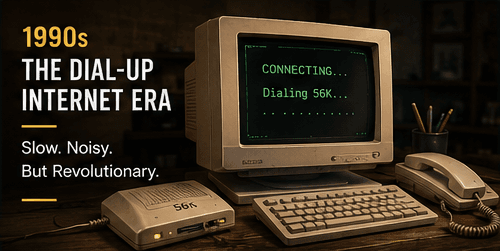
At the same time, commercial online services and internet service providers brought connections into homes. Most consumers used a modem over an ordinary telephone line. The modem converted data into signals that could travel through the voice network, producing the familiar dialing and negotiation sounds before a connection began.
Dial-up imposed clear limits. The line was usually unavailable for a voice call while the modem was connected. Advertised speeds eventually reached 56 kilobits per second, but actual performance varied with line quality and network conditions. A complex page could reveal itself gradually, a software update might take hours and a dropped connection could interrupt the transfer.
Those constraints shaped early online culture. Pages were lighter, images were compressed and people often connected for a specific task before disconnecting. Email, chat rooms, newsgroups, forums and personal homepages created new communities, while portals and search engines tried to organize a rapidly growing collection of information.
The 1990s also marked a shift from a research-oriented network toward a commercial and public medium. Businesses experimented with e-commerce and advertising, publishers moved news online, and governments and schools began offering digital resources. Access was uneven, but the idea that anyone could publish globally—and that a connected computer could reach information beyond its local software—changed expectations permanently.
Broadband, Wi-Fi and the Participatory Web
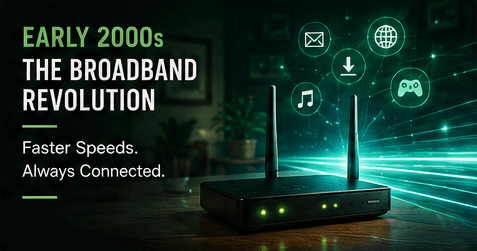
Cable and DSL broadband changed the internet from an occasional dial-up session into a connection that could remain available. Greater capacity reduced waiting, while always-on access allowed applications to communicate in the background. Fiber networks later pushed fixed-line performance much further, although deployment and affordability differed sharply among countries and communities.
Wi-Fi extended that connection around homes, schools and workplaces. Several devices could share one broadband service without a cable at every desk. Laptops became more useful as connected machines, game consoles added online features and households gradually accumulated phones, media devices and appliances that expected network access.
Faster connections changed web design and online business. Pages used larger images, interactive scripts and multimedia. Online banking and shopping became more practical, software distribution moved toward downloads, and services could store user accounts and data on remote servers. The browser was becoming an application platform rather than only a document viewer.
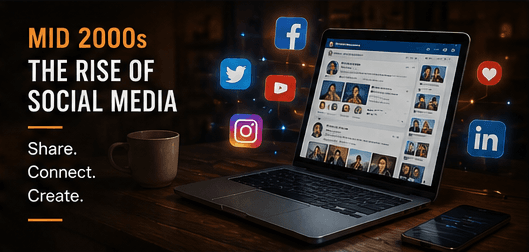
The phrase Web 2.0 described a broader shift toward participation. Blogs, collaborative encyclopedias, photo and video platforms, and social networks made publishing easier for people without their own servers. Users supplied posts, reviews, comments and media; platforms organized those contributions and increasingly funded operations through advertising, subscriptions or transaction fees.
This model created enormous opportunities for community, creativity and small businesses, but it also concentrated attention and personal data inside a limited number of platforms. Moderation, copyright, harassment, privacy and misinformation became central internet-policy questions. The open protocols underneath remained important, yet many everyday experiences were now mediated by private services with their own rules and recommendation systems.
Broadband also changed entertainment. Music downloads, internet radio, online games and early video services placed new demands on networks. Content-delivery networks copied popular files closer to users, reducing delay and backbone traffic. What felt like one website could already involve domain-name services, advertising systems, analytics, payment providers and servers distributed across several regions.
Smartphones Make the Internet Continuous
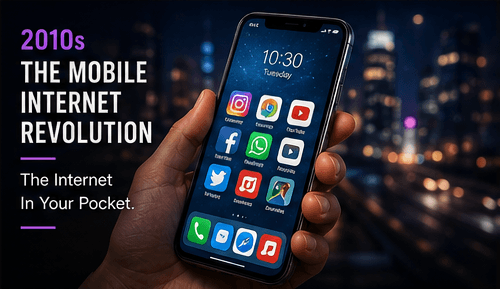
Mobile data existed before the modern smartphone, but the combination of capable touch-screen devices, app platforms, 3G and later 4G networks made full-time internet use practical for a much larger audience. A person no longer needed to sit at a desktop or open a laptop to check a map, send a photo, read news or access an account.
Smartphones placed cameras, location sensors, identity, payments and network access in one personal device. Applications used remote services for messaging, transport, food delivery, banking, entertainment and work. Push notifications made online systems feel continuously present, while social platforms turned real-time photos and short video into everyday communication.
For many people, especially in regions where fixed broadband and computers were less affordable, the phone became the primary or first internet device. Mobile access helped more people come online, but a mobile connection did not automatically provide the same opportunities as affordable high-quality broadband, a larger screen, suitable digital skills and reliable electricity.
The app economy also changed control. Native applications could provide polished experiences and deeper device integration, but distribution increasingly depended on a small number of app stores and mobile platforms. The open Web continued alongside this ecosystem, and many services used both websites and apps connected to the same cloud backends.
Mobile networks evolved from 3G to 4G and then 5G, increasing capacity and supporting lower-latency options. Marketing labels alone do not determine a user's experience: radio spectrum, tower density, backhaul, signal conditions, device support and congestion all matter. Wi-Fi remains important because much smartphone traffic moves through fixed broadband when users are at home or work.
By making access portable and persistent, mobile internet blurred the boundary between being online and offline. That convenience supported navigation, emergency information, remote work and instant communication, but it also introduced new concerns about distraction, location tracking, fraud, surveillance and the pressure to remain reachable.
The Internet as Modern Critical Infrastructure
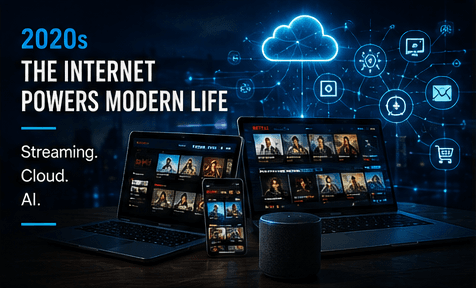
Today's internet is often experienced as streaming, social media, cloud software and AI services, but those products depend on a vast physical and operational system. Undersea fiber-optic cables carry most international data traffic. Terrestrial fiber, mobile towers, satellites, internet exchange points, routers and data centers connect regions and providers. Electricity, cooling, maintenance crews and security teams keep those systems operating.
Cloud computing lets organizations rent processing, storage and managed services instead of owning every server. Content-delivery networks and edge locations place copies or computation nearer to users, which can reduce delay and help services withstand traffic peaks. A single page or app may contact many systems operated by different companies before the user sees a result.
Protocols have also continued to evolve. HTTPS protects web traffic between a client and server when correctly implemented. HTTP/3 maps web communication over QUIC, which provides encrypted transport and manages multiple streams differently from HTTP over TCP. IPv6 offers a far larger address space than IPv4, although both protocols continue to coexist during a long transition.
The internet now supports activities that societies treat as essential: financial transactions, logistics, healthcare systems, public communication, education, work and emergency coordination. That dependence makes outages and attacks more consequential. Resilience requires redundant routes, secure software, careful operations, backup systems and cooperation across organizational and national boundaries.
Scale should not be confused with universal access. The International Telecommunication Union estimated that about 6 billion people—74 percent of the world's population—used the internet in 2025, while 2.2 billion remained offline. Even among users, connection quality, affordability, suitable devices, language, accessibility, skills and online safety affect whether access is meaningful.
Modern internet policy therefore involves more than speed. Societies debate competition, platform responsibility, privacy, encryption, data protection, network neutrality, child safety, cybersecurity and the environmental cost of digital infrastructure. Technical standards can enable communication, but social choices determine how that capability is governed and who benefits.
What the Next Internet May Become
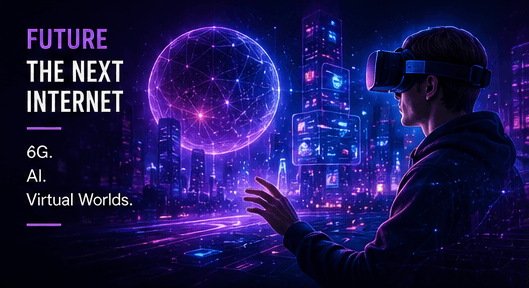
The next internet will not arrive as one clean replacement for today's system. It will grow through upgrades layered onto existing cables, radio networks, protocols, data centers and devices. Fiber deployment, advanced mobile networks and low-Earth-orbit satellite systems may extend capacity and reach, but price, geography, spectrum, regulation and local infrastructure will shape who gains reliable service.
Artificial intelligence is influencing both network operations and the services carried across networks. Operators can use machine-learning systems to detect anomalies, forecast demand or assist with configuration. Users increasingly access generative and predictive systems through online applications. Those workloads can require significant computing capacity and may raise questions about accuracy, privacy, intellectual property, energy use and the concentration of infrastructure.
Edge computing may place more processing near factories, vehicles, hospitals or users when low delay, local operation or data control matters. The Internet of Things will connect more sensors and machines, but every additional device also creates maintenance and security responsibilities. A connected product that stops receiving updates can remain exposed long after it was sold.
Future transport and naming technologies may improve privacy, performance or resilience, while IPv6 deployment can reduce dependence on address-sharing workarounds. Encrypted protocols protect data in transit, but encryption does not automatically make a service trustworthy or anonymous. Security still depends on endpoints, identities, software updates, provider practices and informed users.
Immersive media, spatial interfaces and remote collaboration may demand more consistent latency and capacity. Yet the most important progress may be less visible: affordable service, accessible design, local-language content, stronger infrastructure, longer device support and digital skills. Connecting another billion people meaningfully is not only an engineering challenge.
The internet's history shows why prediction should remain cautious. Open protocols enabled uses that early network builders could not fully foresee, while commercial platforms and social effects created problems that faster links alone cannot solve. Its next phase will be shaped by technical invention, business incentives, public policy and the choices of billions of users. The central question is no longer simply how fast the network can become, but how resilient, open, safe and broadly useful it can remain.
About timelines and future outlooks
This episode is an accessible technology-history overview rather than a complete academic record. Dates, adoption, and availability can vary by country and market. Future sections describe plausible directions based on current developments, not guaranteed outcomes.
Key Takeaways
- ✓The internet is a network of independently operated networks, not one company, cloud or central computer.
- ✓Packet switching and TCP/IP made it practical for different kinds of networks and computers to exchange data using shared rules.
- ✓The World Wide Web runs on the internet but is not the internet; email, calls, games and many apps use the same infrastructure in other ways.
- ✓Dial-up introduced many households to online services, while broadband, Wi-Fi and mobile networks turned connectivity into an everyday utility.
- ✓Modern experiences depend on data centers, cloud platforms, content-delivery networks and undersea cables as well as the user's local connection.
- ✓More people are online than ever, but affordability, quality, skills, safety and reliable access still create a substantial digital divide.
FAQ
Frequently Asked Questions
Quick answers about this episode's topic.
Continue Learning
Related guides and browser tools
Understand a key concept in more detail or try a practical tool connected to this episode.
Tech Explained
What Happens When You Type a URL?
Follow one browser navigation through URL parsing, DNS, transport security, HTTP, server processing, caching, and page rendering.
Read explainerTech Explained
How Websites Work
See how Internet infrastructure supports domains, HTTPS, servers, browser rendering, frontend code, and backend services.
Read explainerTech Explained
How Does the Internet Really Work?
Follow how networks, IP addresses, DNS, packets, routers, servers, and web protocols work together.
Read explainerTech Explained
How DNS Works
See how domain names are resolved through caches, recursive resolvers, and authoritative DNS servers.
Read explainerBrowser Tool
IPv4 Subnet Calculator
Explore IPv4 addresses, CIDR ranges, subnet masks, network boundaries, and usable hosts.
Open toolTech Pioneer
Vint Cerf
Meet the co-designer of TCP/IP and learn why internetworking protocols mattered.
Read profileTech Pioneer
Tim Berners-Lee
Read how HTML, HTTP, URLs, and the World Wide Web made the internet easier to use.
Read profileMore in this series
Related episodes
Continue with nearby episodes from the Then vs Now series.

Episode 2: Computers: Then vs Now
How room-sized electronic machines evolved into personal computers, laptops, cloud systems and today's AI-assisted PCs.
Read episode
Episode 4: Cameras: Then vs Now
How roll film, digital sensors, mirrorless systems, smartphones and computational photography changed the way images are captured and shared.
Read episode
Episode 1: Phones: Then vs Now
How mobile phones evolved from analog brick phones through GSM, feature phones, touchscreen app platforms, 5G and AI-assisted smartphones.
Read episode