The Rise of AI Agents: From Chatbots to Autonomous Workers
AI agents can move beyond conversation by selecting tools, taking actions, checking results, and adapting within defined limits. Learn how they work, where they help, and why permissions, evaluation, and human oversight matter.

Listen to this article
The Rise of AI Agents: From Chatbots to Autonomous Workers
15 parts · Tap play to start
Uses a natural English voice available through your browser or device. Article text is not uploaded to NVR Nexus.
Introduction
Generative AI first reached many people through chat interfaces. A person entered a request, the model produced a response, and the interaction paused until the next message. AI agents extend that pattern by connecting a model to tools and allowing the surrounding system to continue through several steps toward an objective.
An agent might search approved information, read a document, query a database, edit a file, run a test, create a draft, or ask another service to perform an operation. After each action, it observes the result and decides what to do next. That ability to combine reasoning with action is what makes agents useful—and what makes them more difficult to control than ordinary chatbots.
The phrase autonomous worker can be misleading if it suggests unlimited independence or human-like understanding. Real agents operate inside software boundaries. Their effective autonomy depends on their tools, credentials, instructions, memory, approval rules, time limits, budget, and the quality of the model directing them.
This article explains the technology without treating autonomy as automatically desirable. The important question is not how much freedom an agent can receive. It is how much authority a particular task requires, how reliably the result can be checked, and which decisions must remain with a responsible person.
An AI agent is not just a model that produces an answer. It is a system that lets a model choose and perform actions within defined limits.
Chatbots, Workflows, and AI Agents Are Different
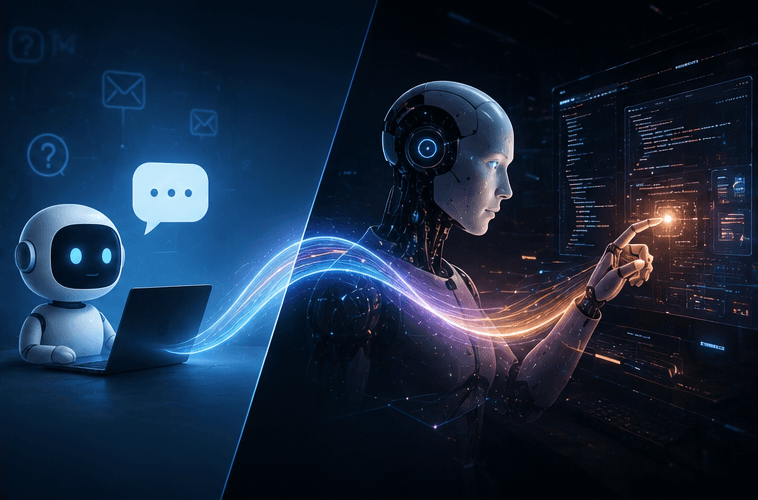
A chatbot mainly exchanges messages. It can answer a question, summarize supplied text, or draft content, but it does not necessarily take action in another system. Adding retrieval may help it answer from approved documents, yet the interaction can still remain a single request-and-response experience.
A workflow follows a path designed in advance. Code might classify a support request, send it to one of three specialized prompts, validate the result, and require approval before a refund. Language models can participate in several steps, but the software—not the model—determines the sequence.
An AI agent has more discretion over the path. Given an objective and a set of available tools, it can decide which action to try, inspect the result, revise its plan, and continue until it reaches a stopping condition or needs human input. The path can vary even when two tasks begin with similar instructions.
These categories overlap in products and marketing language, so the label alone tells users very little. A more useful description states what the system can access, which actions it can perform, what it can change, how long it can operate, and where human confirmation is required.
- Chatbot: primarily generates a response for a person.
- Workflow: follows a predefined sequence with model-assisted steps.
- Agent: chooses among tools and next steps based on intermediate results.
- Agentic system: a broad term that may include workflows, one agent, or several coordinated agents.
How an AI Agent Works
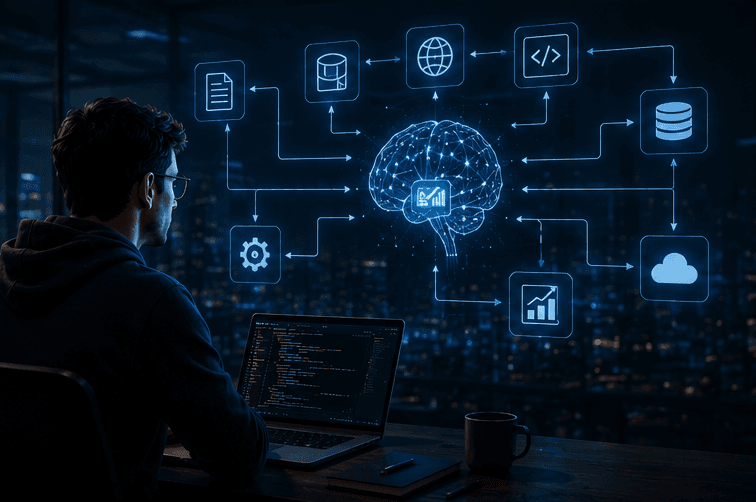
Most language-model agents follow a loop. The system receives an objective, instructions, relevant context, and descriptions of the tools it is allowed to use. The model proposes a next action. The application validates and executes that action, returns the result, and asks the model to continue or finish.
Tools turn generated language into operations. A tool might perform a search, retrieve a customer record, run code in a sandbox, send a draft for approval, update a project ticket, or call a business API. The model usually does not access these systems directly; application code translates a structured tool request into a controlled operation.
Context contains the information available during the current run: the user's request, instructions, tool results, documents, and earlier messages. What is often called memory may be a saved summary, database record, retrieval index, user preference, or task state supplied again later. It is not necessarily learning in the human sense or a permanent change to the underlying model.
The loop needs stopping conditions. Completion criteria, maximum steps, time and cost limits, repeated-failure detection, human checkpoints, and cancellation controls prevent the system from continuing indefinitely. A capable agent should also be able to report uncertainty or explain why it cannot proceed safely.
- Receive an objective, constraints, and available context.
- Select the next tool or information-gathering step.
- Validate and execute the proposed action.
- Observe the real result rather than assuming the action succeeded.
- Update the plan, request help, complete the task, or stop at a limit.
Autonomy Is a Spectrum, Not an On-Off Switch
An agent can be tightly supervised or relatively independent. At one end, it only recommends an action and a person performs it. A step further, the system prepares a change but waits for approval. It may be allowed to execute reversible, low-risk actions automatically while asking for confirmation before spending money, contacting someone, deleting information, publishing content, or changing production systems.
The correct level depends on consequence and recoverability. Sorting internal documents and drafting a reply are not equivalent to approving a payment or changing medical treatment. A task may also move between levels: an agent can research independently, create a proposed plan, and stop before execution.
Good design makes authority explicit. Users should know whether an agent is reading, recommending, drafting, or acting. Approval prompts should describe the exact operation and its effect rather than asking for vague permission to continue.
More autonomy is not automatically a better product. Constraints can improve trust, predictability, security, and user control. In many environments, the most useful system is a workflow or supervised agent that handles routine steps while escalating ambiguous and consequential decisions.
When an Agent Is the Right Tool

Agents are most useful when the route to a valid outcome cannot be completely predicted in advance. The work may involve unstructured documents, changing information, several software systems, exceptions, and a need to choose different steps according to what is discovered.
Research assistance is one example. An agent can create search queries, collect material from approved sources, compare documents, identify gaps, and prepare a cited draft for review. Customer-support systems can gather account context, classify a problem, propose a response, and perform a limited action when policy conditions are met. Operations teams can use agents to investigate alerts, assemble evidence, and recommend a remediation plan.
A traditional solution is often better when the rules are stable, the input is structured, and the required result is deterministic. Calculating tax from a known formula, validating a schema, moving a file on a schedule, or enforcing an authorization rule does not need model-directed planning. Ordinary software is normally faster, cheaper, easier to test, and more predictable for such work.
Before building an agent, teams should ask whether a simpler prompt, search interface, workflow, rules engine, or conventional application can solve the problem. Agent complexity introduces additional latency, cost, observability needs, and failure paths, so it should earn its place through measurable value.
- Good fit: variable multi-step work with clear goals and checkable intermediate results.
- Possible fit: unstructured information, frequent exceptions, or several tools that must be coordinated.
- Poor fit: fixed calculations, strict rules, extremely low latency, or tasks with no reliable way to verify success.
- High-risk fit: consequential actions require narrow permissions, strong controls, and meaningful human responsibility.
AI Agents in Software Engineering

Software work is a natural agent use case because tools can inspect repositories, edit files, run tests, search documentation, and return concrete feedback. A coding agent may trace a defect, propose a patch, update tests, run static analysis, and summarize the resulting change.
The environment provides useful verification signals, but passing tests is not proof that a change is correct. Existing tests can be incomplete, the agent may misunderstand a requirement, and a locally valid implementation can violate architecture, security, accessibility, performance, licensing, or operational expectations.
Teams should give coding agents isolated workspaces, limited credentials, approved commands, and explicit boundaries around secrets and production resources. Proposed changes should remain reviewable. The responsible engineer needs to understand the diff, verify important behavior, and decide whether the change belongs in the system.
The greatest value often comes from reducing mechanical effort: navigating an unfamiliar repository, preparing a first implementation, generating test ideas, explaining an error, or making a bounded change across several files. Architecture, product intent, risk acceptance, and ownership remain human and organizational responsibilities.
Single-Agent and Multi-Agent Systems
A single agent with a clear toolset is usually the simplest starting point. It has one instruction set, one task history, and one place to inspect decisions. This makes behavior easier to understand and reduces the communication overhead introduced by delegation.
Multi-agent designs assign different roles or subtasks to separate model instances. One agent might plan, several might investigate independent areas, and another might compare or combine results. Parallel work can help when subtasks are genuinely independent, and specialization can help when tools or instructions should remain separate.
More agents do not automatically create more intelligence. They add messages, cost, latency, duplicated work, coordination failures, and additional trust boundaries. One agent can pass incorrect context to another, disagreements require resolution, and a mistake can spread through the system before it becomes visible in the final answer.
Use multiple agents when the task structure and evaluation justify them—not because a diagram looks more advanced. Teams should first test whether one well-designed agent or deterministic workflow can deliver the same outcome with fewer moving parts.
Why Agents Fail
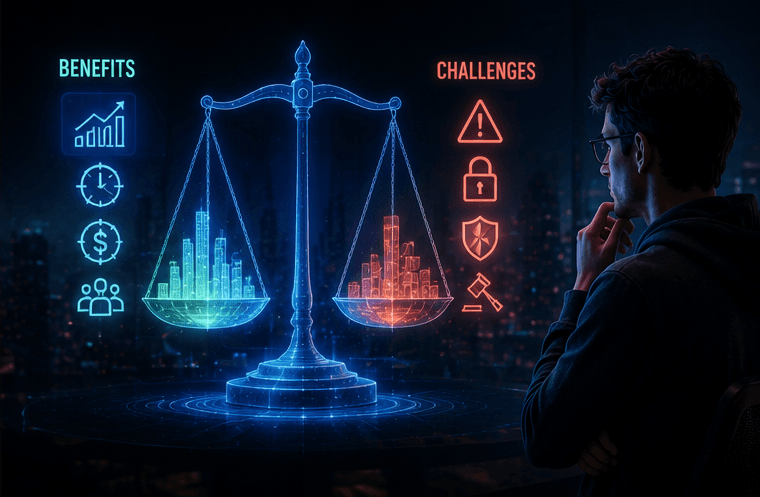
Agents inherit model limitations and add system-level risks. A model can misunderstand an instruction, generate unsupported information, choose the wrong tool, construct invalid parameters, or continue confidently after an early mistake. Because later steps depend on earlier observations, one error can cascade through a long task.
Context is limited and imperfect. Important information may be missing, retrieved material may be outdated, tool output may be ambiguous, and a long run may compress or lose details. Persistent memory can preserve useful preferences, but it can also preserve incorrect or malicious information if writes are not validated.
Agents can also waste resources by repeating unsuccessful actions, opening too many branches, or using expensive tools without improving the result. Network failures, expired credentials, changed interfaces, rate limits, and partial updates create ordinary distributed-system problems in addition to model uncertainty.
These failures are not solved by asking the model to be more careful. Reliable systems combine narrow tools, validation, retries with limits, idempotent operations where possible, transaction and rollback design, clear error handling, independent checks, monitoring, and human escalation.
- Planning error: the chosen path does not satisfy the real objective.
- Tool error: the action, parameters, or target are wrong.
- Observation error: the agent misreads or ignores the result.
- Context error: relevant information is missing, stale, or misleading.
- Control error: the system lacks an effective stop, approval, or recovery path.
Security, Identity, and Permission Boundaries
The main security difference between a chatbot and an agent is consequence. A misleading sentence is harmful; a misleading sentence connected to email, files, code execution, payments, or administrative systems can become an action with lasting effects.
Agents often read untrusted content such as webpages, documents, messages, issue descriptions, and tool output. That content can contain instructions intended to redirect the model, a problem known as indirect prompt injection or agent hijacking. A system cannot safely assume that text retrieved from the environment is only data.
Least privilege is essential. Each tool should expose the smallest useful operation, credentials should be scoped to the task, and sensitive actions should require independent policy checks or confirmation. Read and write capabilities should be separated where possible. Temporary credentials, destination allowlists, spending limits, sandboxing, and rate limits reduce the damage a mistaken or manipulated action can cause.
Identity also matters. The system should record which user authorized the task, which agent identity performed each operation, what permissions were active, and what information supported the decision. Logs need to be useful for investigation without leaking secrets or sensitive user data.
A human approval step is not meaningful if the reviewer receives hundreds of unclear requests or cannot understand the proposed action. High-impact approvals should be rare, specific, and supported by enough context for a person to make a real decision.
Evaluating an Agent Before and After Release
A chatbot can sometimes be evaluated by the quality of one response. An agent must also be evaluated through its trajectory: which tools it selected, whether actions stayed within scope, how it handled unexpected results, how much time and money it used, and whether it knew when to stop or ask for help.
A useful evaluation set contains realistic tasks, edge cases, adversarial inputs, permission boundaries, tool failures, and examples where the correct behavior is to refuse or escalate. Teams should preserve expected outcomes and important intermediate constraints rather than relying only on a model to judge another model's final response.
Metrics should match the workflow. Task completion is important, but so are factual accuracy, policy compliance, unauthorized-action rate, human correction, latency, cost, escalation quality, and recovery from failure. A system that completes more tasks while creating harder-to-detect errors may be worse overall.
Production monitoring is necessary because models, tools, prompts, data, and user behavior change. Traces should make tool calls and state transitions understandable. Incidents and user corrections should feed back into evaluation cases so the test suite reflects failures that occurred in the real environment.
- Did the agent achieve the requested outcome without exceeding scope?
- Were important claims and actions grounded in real tool results?
- Did permissions, approval gates, and stopping conditions work?
- Could a reviewer reconstruct what happened and why?
- Did performance remain acceptable across cost, latency, quality, and safety measures?
Human–Agent Collaboration and the Future of Work

AI agents are likely to change collections of tasks before they replace complete occupations. A researcher may delegate document collection but still judge source quality. A support specialist may receive a prepared case summary but decide how to handle an unusual customer. A developer may ask an agent to implement a bounded change but remain accountable for the system that ships.
As execution becomes easier to delegate, skills in problem framing, domain knowledge, verification, security, process design, communication, and exception handling become more important. People need to define what a good result means, identify what the system is not allowed to do, and recognize when the situation falls outside the agent's competence.
Organizations must avoid creating responsibility gaps. A model cannot accept legal, professional, or moral accountability. Every deployed agent needs an identifiable owner for permissions, quality, incidents, user support, and retirement. Workers affected by the system should receive training and a practical way to challenge or correct its output.
The most credible future is not one in which every process becomes fully autonomous. It is one in which organizations choose deliberately among ordinary software, model-assisted workflows, supervised agents, and more independent systems according to evidence and risk.
A Practical Adoption Checklist
A successful pilot starts with one bounded outcome and a baseline for the current process. Teams should know what success means before adding an agent, otherwise impressive demonstrations can replace measurable improvement.
- Define the objective, non-goals, acceptable uncertainty, and evidence of completion.
- Choose the simplest architecture that can solve the task; prefer a workflow when the path is known.
- List every data source, tool, credential, external system, and side effect the agent can reach.
- Apply least privilege and require confirmation for consequential or difficult-to-reverse actions.
- Create realistic evaluations, including failures, attacks, ambiguous requests, and required escalations.
- Set limits for steps, time, cost, retries, memory, and concurrent work.
- Trace actions and results while protecting secrets and personal information.
- Assign a human owner and prepare rollback, incident response, user support, and retirement plans.
- Compare production outcomes with the original baseline before expanding authority or scale.
Frequently Asked Questions
Conclusion
AI agents extend generative models from producing answers toward performing multi-step work. Their value comes from combining flexible language understanding with tools, feedback from the environment, and the ability to adapt a plan.
Those same capabilities increase risk. An agent can propagate an early mistake, misuse an authorized tool, be redirected by untrusted content, consume unexpected resources, or take an action that is harder to undo than a bad chat response. Reliable deployment therefore depends on engineering controls and organizational responsibility, not model capability alone.
The strongest agent systems will not be the ones advertised as having the most autonomy. They will be the ones that solve a well-chosen problem, use the minimum necessary authority, expose their work to evaluation, involve people at meaningful decision points, and stop safely when evidence or permission is missing.
Knowledge Hub
Learn the fundamentals first
Plain-language explainers to help you understand the concepts behind this article.

Share this article
Keep reading
Related Articles
More stories on similar topics from the NVR Nexus blog.
AI Won’t Replace Developers — But Developers Using AI Will
AI can generate code, tests, and documentation, but building dependable software still requires human judgment. The real shift is from writing every line manually to directing, verifying, and integrating AI-assisted work.

How AI Is Changing Media and Journalism
Artificial intelligence is changing how newsrooms research stories, analyze evidence, create formats, reach audiences, and verify digital media. The opportunity is significant—but so are the risks to accuracy, transparency, trust, and editorial independence.

How AI Is Changing the Legal Industry
Artificial Intelligence is transforming the legal industry through contract analysis, legal research, document automation, compliance monitoring, and predictive case insights. Discover how AI is reshaping the future of legal services.