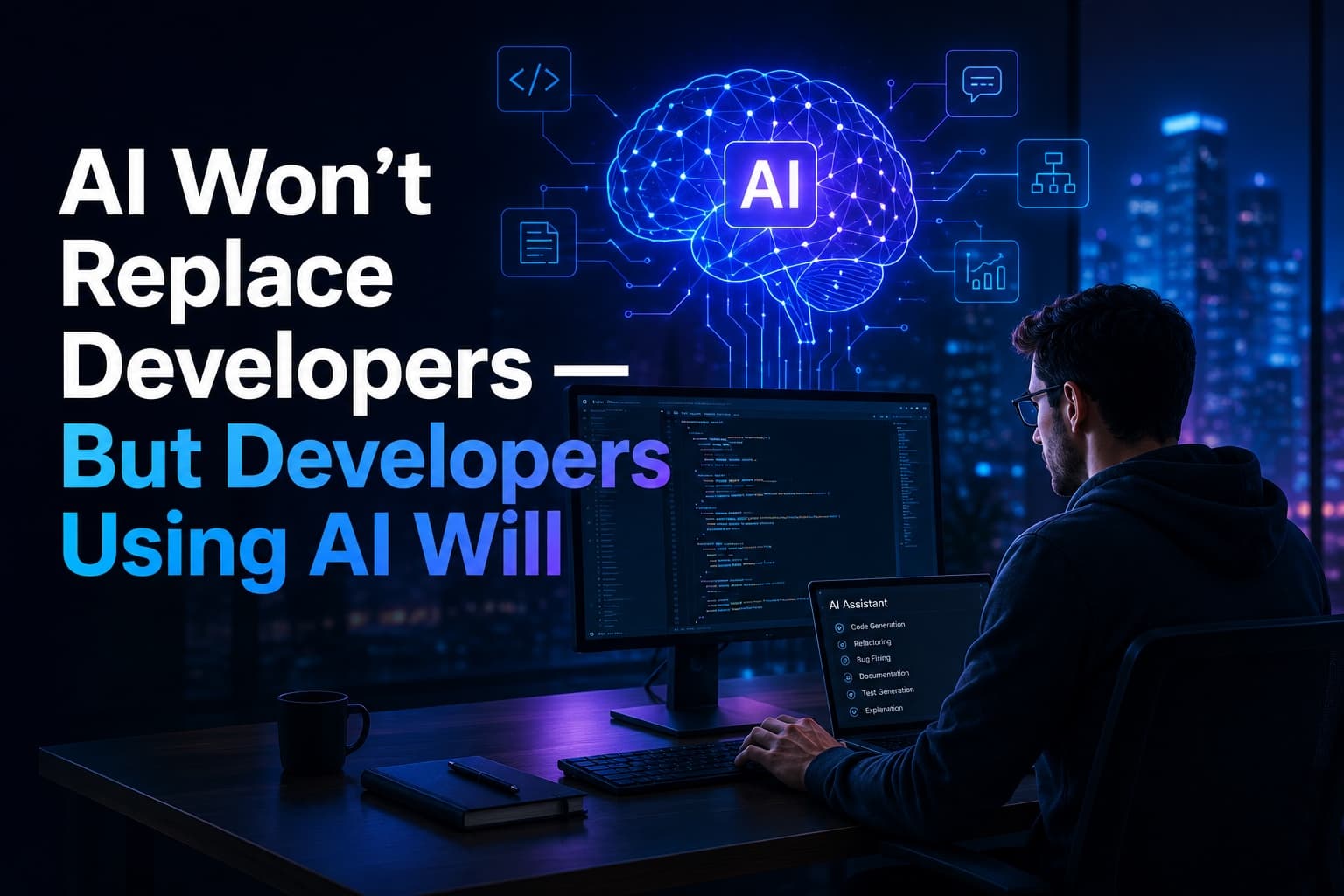
AI Won’t Replace Developers — But Developers Using AI Will
AI can generate code, tests, and documentation, but building dependable software still requires human judgment. The real shift is from writing every line manually to directing, verifying, and integrating AI-assisted work.
Listen to this article
AI Won’t Replace Developers — But Developers Using AI Will
14 parts · Tap play to start
Uses a natural English voice available through your browser or device. Article text is not uploaded to NVR Nexus.
Introduction
Artificial intelligence can now turn natural-language instructions into functions, tests, database queries, documentation, and small applications. That progress has made a reasonable question feel urgent: if a machine can write code, will companies still need software developers?
The question treats code as the entire job. In practice, a production system begins with an uncertain human need and passes through requirements, architecture, security, data design, implementation, testing, deployment, monitoring, maintenance, and accountability. Code is essential, but it is only one part of that chain.
AI is likely to automate parts of software work and reduce the time required for others. It may also change team sizes, entry-level tasks, and the skills companies reward. That is not the same as making developers unnecessary. It means the role is moving toward clearer problem definition, faster experimentation, stronger verification, and responsibility for systems assembled with both human-written and machine-generated code.
The developers with the strongest advantage will not be those who accept every AI suggestion or those who refuse the tools entirely. They will be the people who know when AI is useful, how to supply the right context, how to inspect its output, and when a problem requires direct human reasoning instead.
AI changes the cost of producing code. It does not remove the responsibility of deciding what software should do or proving that it works.
What the Replace-Developers Debate Gets Wrong
Predictions about the end of programming often measure how quickly a tool can produce a visible demo. A demo can be impressive while avoiding the difficult parts of real software: incomplete requirements, existing systems, private data, unusual failures, regulatory constraints, performance targets, accessibility, migrations, and years of maintenance.
Software engineering is a decision-making discipline. A developer must decide which problem is worth solving, what trade-offs are acceptable, how components should interact, what can fail, how damage will be limited, and how another person will understand the system later. Those decisions depend on business context and organizational knowledge that are rarely contained in one prompt.
The word replacement also hides differences between tasks and roles. Generating a validation function is not the same as owning a payment platform. Converting a design into a first-pass interface is not the same as understanding why customers abandon a workflow. AI may replace a task, compress a phase, or change who performs an activity without replacing the profession that coordinates the whole outcome.
- Code generation is one activity inside a much larger delivery process.
- A working example is not automatically secure, maintainable, accessible, or production-ready.
- Business knowledge, system history, and risk tolerance are often undocumented or distributed across people.
- Someone must remain accountable when an automated suggestion causes a failure.
What AI Can Do Well Today
AI coding assistants are most useful when a task is bounded, the surrounding context is available, and a developer can verify the result quickly. They can reduce the time spent recalling syntax, writing repetitive structures, exploring an unfamiliar API, or creating the first version of routine code.
They can also act as an interactive explanation layer. A developer can ask for a walkthrough of a function, compare two implementation approaches, generate test cases, translate a stack trace into possible causes, or summarize a pull request. These uses shorten the path from question to investigation, even when the first response is not the final answer.
The benefit is not simply faster typing. Used carefully, AI can lower the cost of trying alternatives. A team can explore a rough prototype, identify missing requirements, and discard weak ideas before investing in a polished implementation. The developer still decides which alternative fits the product and validates whether the generated work is correct.
- Generate boilerplate, adapters, schemas, and routine transformations.
- Explain unfamiliar code and suggest places to investigate an error.
- Draft unit tests, test data, documentation, and migration notes.
- Propose refactoring options and translate code between languages or frameworks.
- Create prototypes that help teams clarify a requirement before full implementation.
- Review a small change for obvious omissions while a human performs the final review.
Where AI-Generated Code Fails
AI produces likely output from the context it receives. It does not independently know whether a requirement is complete, whether an internal rule changed yesterday, or whether a plausible library method actually exists in the installed version. A response can look polished while containing a subtle factual or logical error.
Generated code may mishandle edge cases, trust unsafe input, expose secrets, use an outdated dependency, introduce inefficient queries, or solve a slightly different problem from the one intended. The risk increases when the surrounding codebase is large, the domain is specialized, or the system has constraints that were not included in the prompt.
There is also a verification trap. AI can generate more code than a developer can thoughtfully review. If output volume rises while review quality stays fixed, a team may ship faster but accumulate defects, security risks, and code that nobody fully understands. Productivity should therefore be measured by dependable outcomes—not by generated lines or completed prompts.
- Confident but nonexistent APIs, options, citations, or package behavior.
- Incomplete authorization, validation, privacy, and error-handling logic.
- Tests that repeat the implementation’s mistake instead of challenging it.
- Changes that work locally but conflict with architecture, deployment, or operational constraints.
- Code copied into the product without clear provenance, licensing review, or team understanding.
A Practical Human–AI Development Workflow
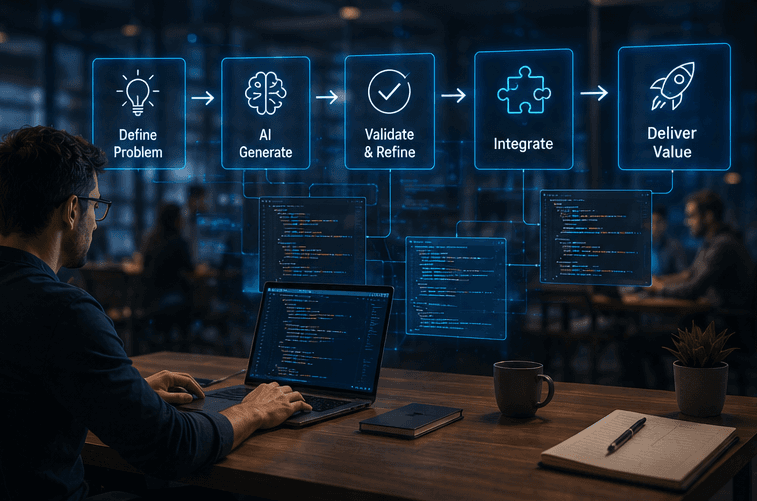
A reliable AI-assisted workflow keeps human decisions visible. The developer begins by defining the outcome, constraints, interfaces, and acceptance criteria. AI can then help produce a small, reviewable change rather than an uncontrolled rewrite of the system.
The output should be treated like a contribution from a fast but unfamiliar collaborator. Read it, question its assumptions, run it, test failure paths, check security boundaries, and compare it with project conventions. If the developer cannot explain the code, the work is not ready merely because it passes a superficial test.
Small feedback loops are safer than one large prompt. Ask for a plan, inspect it, provide missing context, generate one component, verify it, and then continue. This makes errors easier to locate and preserves the developer’s understanding of how the solution was assembled.
- Define: state the user need, constraints, non-goals, and acceptance criteria.
- Provide context: include relevant interfaces, examples, versions, conventions, and failure expectations.
- Generate narrowly: request a small change that can be reviewed independently.
- Verify: inspect the diff, run tests and static checks, and test negative and boundary cases.
- Integrate: confirm observability, documentation, accessibility, security, and deployment behavior.
- Own the result: record important decisions and keep a human responsible for approval.
How the Developer Role Is Changing
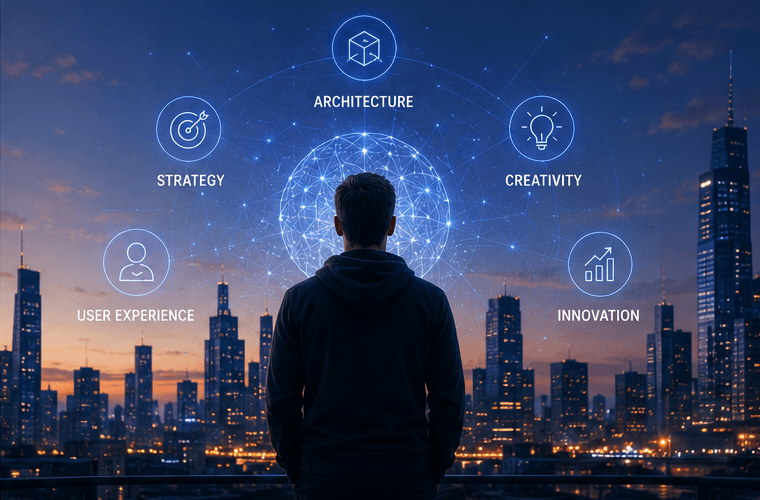
When routine implementation becomes cheaper, the value of deciding what to build and judging whether it is good increases. Developers may spend less time producing standard scaffolding and more time shaping requirements, designing interfaces, evaluating alternatives, reviewing generated changes, and observing how software behaves in production.
This does not mean every developer becomes a manager or stops coding. Direct coding remains important for understanding performance, debugging difficult behavior, building novel components, and verifying suggestions. The shift is toward using code as one tool within a broader engineering process rather than treating manual code production as the sole measure of contribution.
Teams may also become more cross-functional. A developer who can connect product goals, user experience, data, security, and operations can use AI more effectively because they can provide better constraints and detect when a technically plausible answer harms another part of the system.
Skills That Become More Valuable
AI does not make technical foundations irrelevant. It makes weak foundations harder to hide. A developer needs enough knowledge of programming, networks, databases, security, testing, and system behavior to recognize when a generated answer is incomplete or unsafe.
The durable advantage is a combination of technical depth and contextual judgment. Prompting can help express a task, but the quality of the result depends more on understanding the problem, selecting useful context, and evaluating the answer than on discovering a clever phrase.
- Problem framing: turning an ambiguous request into testable requirements and explicit constraints.
- System design: understanding boundaries, data flow, failure modes, scalability, and trade-offs.
- Code and security review: detecting subtle defects, unsafe assumptions, and maintainability problems.
- Testing and observability: proving expected behavior and learning from production signals.
- Domain knowledge: understanding the people, rules, risks, and vocabulary behind the software.
- Communication: explaining decisions, uncertainty, alternatives, and consequences to technical and nontechnical partners.
- AI literacy: knowing a tool’s data policy, context limits, failure patterns, and appropriate use cases.
What This Means for Junior Developers
Entry-level work will change because many traditional starter tasks—simple components, routine tests, documentation drafts, and basic bug fixes—can now be accelerated by AI. The danger is that beginners may complete tasks without building the mental models that allow experienced engineers to diagnose failures later.
Junior developers should use AI as a tutor and reviewer, not as an invisible substitute for learning. Ask it to explain alternatives, predict failure cases, or create exercises. Then implement important parts directly, read the generated code line by line, and confirm the behavior with documentation and tests.
Organizations share responsibility for preserving the learning path. If every easy task is automated and no one explains the system, the team may gain short-term speed while failing to develop future senior engineers. Pairing, code review, design discussions, incident analysis, and gradual ownership remain essential.
Which Work Is Most Exposed to Automation?
Tasks are more exposed when they are repetitive, well specified, easy to verify, and similar to widely available examples. Standard data transformations, common interface patterns, basic test scaffolding, and routine documentation often fit this description.
Work is less easily automated when requirements are contested, consequences are significant, context is private or incomplete, and success depends on coordinating people. Architecture for a complex organization, security response, safety-critical systems, legacy modernization, product discovery, and incident leadership require more than generating a plausible implementation.
The boundary will continue to move. Developers should not build a career around being the fastest person at a task that tools steadily commoditize. They should use automation for that task and move their attention toward understanding systems, users, risks, and decisions that remain difficult to specify and evaluate.
Responsible AI Practices for Development Teams
Individual skill is not enough when AI is used across an organization. Teams need rules that match safeguards to risk. A tool approved for public sample code may not be suitable for customer data, private repositories, credentials, security incidents, or confidential product plans.
Policies should be practical enough to follow during normal work. Developers need to know which tools are approved, what information may be shared, when generated code requires additional review, how licensing concerns are handled, and who responds when an AI-assisted change causes an incident.
- Protect secrets, personal data, proprietary code, and confidential business information.
- Review provider retention, training, access, and enterprise-control settings before adoption.
- Require ordinary code review, tests, scanning, and change-management controls for generated code.
- Use stronger review for authentication, payments, infrastructure, privacy, and safety-sensitive features.
- Track tool and model changes when reproducibility or regulated evidence matters.
- Measure escaped defects, review time, maintainability, and customer outcomes—not only generation speed.
How Developers Can Prepare Now
Preparation does not require chasing every new model. Choose one approved assistant and apply it to a real but low-risk workflow. Compare the time and quality with your normal approach, note where verification takes longer than expected, and build a repeatable process around the uses that genuinely help.
Continue strengthening fundamentals and build projects that require more than a generated interface. Work with authentication, persistent data, accessibility, monitoring, deployment, failure recovery, and user feedback. These experiences develop the judgment needed to supervise AI-assisted work.
- Practice asking for a plan and assumptions before asking for code.
- Review every generated diff and explain it in your own words.
- Write or improve tests that challenge edge cases instead of only confirming the happy path.
- Learn the architecture and business purpose of the systems you maintain.
- Keep a short record of which AI uses save time and which create extra review work.
- Develop communication, product thinking, security awareness, and incident-response skills alongside coding.
Frequently Asked Questions
Conclusion
AI is changing software development because it makes code, explanations, and alternatives cheaper to produce. That will reduce some routine work, alter how people learn, and raise expectations for how quickly teams can experiment.
It does not remove the hard parts of engineering. Someone must still understand the need, choose the trade-offs, protect users, connect the solution to existing systems, verify its behavior, and remain responsible after deployment. Faster generation makes those responsibilities more important because teams can create mistakes at greater speed and scale.
The useful distinction is therefore not developers versus AI. It is unverified automation versus accountable engineering. Developers who combine technical foundations, domain knowledge, careful review, and effective AI use will be better positioned than those who either trust the tools blindly or ignore how the work is changing.
Knowledge Hub
Related Tech Explained topics
Plain-language explainers to help you understand the concepts behind this article.

Tech Explained · Artificial Intelligence
What is Artificial Intelligence (AI)?
Understand what artificial intelligence is, how AI systems learn and produce outputs, how machine learning and generative AI differ, and how to assess their benefits and risks.

Tech Explained · Software Development
What is an API (Application Programming Interface)?
Understand what an API is, how requests and responses work, how REST, GraphQL, RPC and webhooks differ, and how authentication, errors, versioning and security shape reliable integrations.
Share this article
Keep reading
Related Articles
More stories on similar topics from the NVR Nexus blog.

The Rise of AI Agents: From Chatbots to Autonomous Workers
AI agents can move beyond conversation by selecting tools, taking actions, checking results, and adapting within defined limits. Learn how they work, where they help, and why permissions, evaluation, and human oversight matter.

How AI Is Changing Media and Journalism
Artificial intelligence is changing how newsrooms research stories, analyze evidence, create formats, reach audiences, and verify digital media. The opportunity is significant—but so are the risks to accuracy, transparency, trust, and editorial independence.

How AI Is Changing the Legal Industry
Artificial Intelligence is transforming the legal industry through contract analysis, legal research, document automation, compliance monitoring, and predictive case insights. Discover how AI is reshaping the future of legal services.