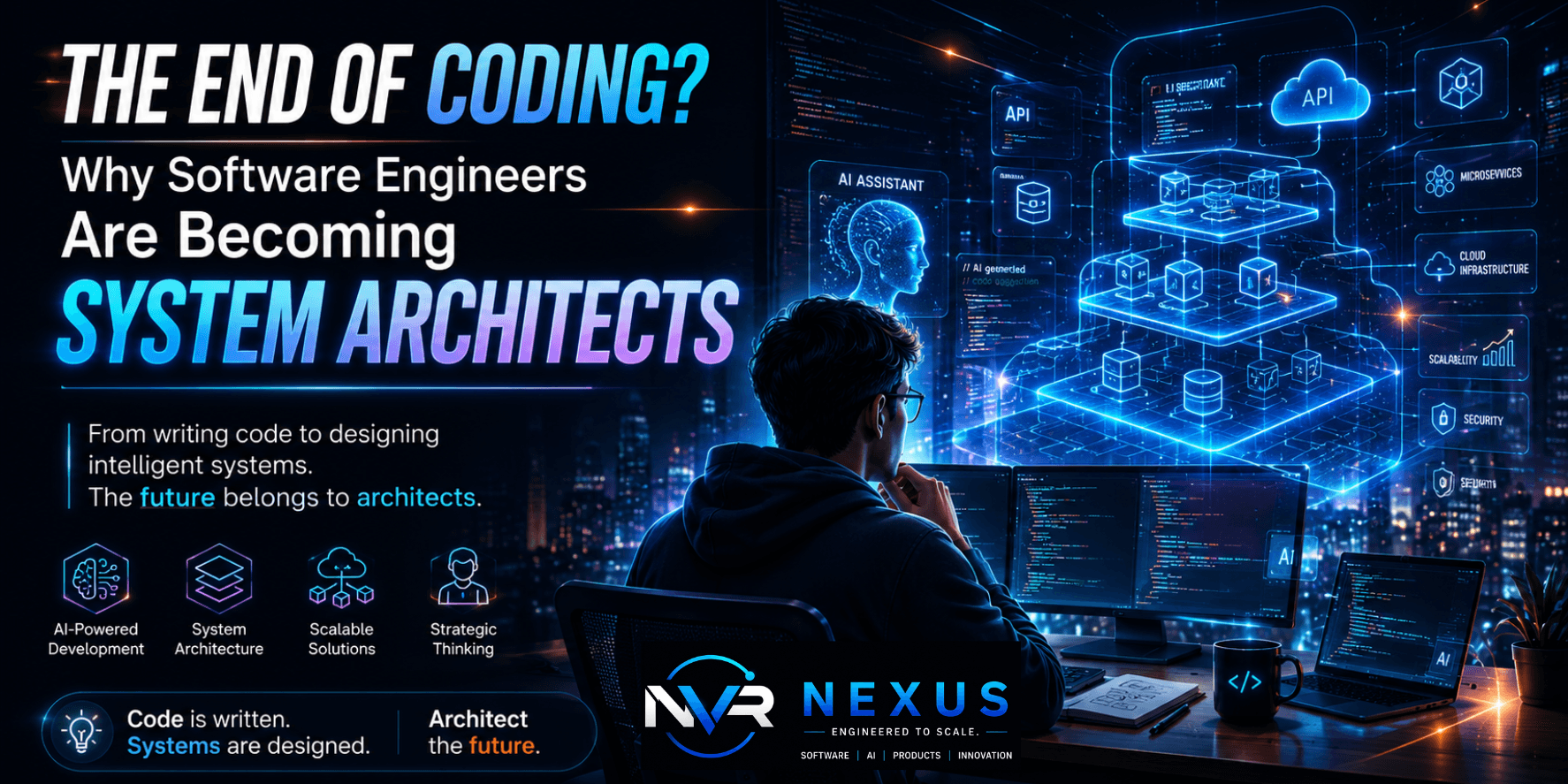
The End of Coding? Why Software Engineers Are Becoming System Architects
AI can produce code faster, but dependable software still depends on architecture, verification, security, operations, and product judgment. The engineer’s role is expanding from implementation toward ownership of the whole system.
Listen to this article
The End of Coding? Why Software Engineers Are Becoming System Architects
15 parts · Tap play to start
Uses a natural English voice available through your browser or device. Article text is not uploaded to NVR Nexus.
Introduction
Software engineering has never been only the act of typing source code. Engineers translate uncertain needs into behavior, decide how data and components should interact, protect security boundaries, test assumptions, deploy changes, observe production, and maintain systems long after the first release. Code is the material through which many of those decisions are expressed, but it is not the entire profession.
Generative AI makes this distinction harder to ignore. Coding assistants can create functions, tests, interfaces, queries, infrastructure definitions, documentation, and multi-file changes in minutes. Agentic tools can inspect repositories, run commands, revise an implementation, and prepare a proposed change. The cost of producing a plausible first draft has fallen dramatically.
That does not mean reliable software has become automatic. More generated code creates more behavior to understand, review, secure, integrate, operate, and eventually replace. The engineering bottleneck moves from producing syntax toward controlling complexity and making good decisions across the full lifecycle.
The phrase ‘engineers are becoming system architects’ describes this wider responsibility, not a universal job-title change. Strong engineers will still write and debug code. They will increasingly be judged by whether the whole system solves the right problem, survives failure, protects users, and remains understandable to the next team.
Code is becoming less expensive to produce. Deciding what the code should do—and proving that the complete system is dependable—is becoming more valuable.
Coding Is Not Ending

Programming is not disappearing. AI-generated output must still become executable software, and direct coding remains essential when a problem is novel, performance-sensitive, security-critical, deeply coupled to an existing codebase, or difficult to describe precisely. Engineers also need coding fluency to investigate failures and judge whether generated changes are sound.
What is changing is the amount of manual effort required for some implementation tasks. Standard data transformations, familiar interface patterns, test scaffolding, migrations, adapters, and documentation drafts can often be produced faster with assistance. This makes routine code less scarce, but it does not make correct behavior, maintainable design, or organizational context less scarce.
The most useful comparison is not human code versus machine code. It is accountable engineering versus unverified output. A manually written change can be poor, and an AI-assisted change can be excellent. The difference is whether the team understood the requirement, constrained the solution, inspected the implementation, tested meaningful failure cases, and accepted responsibility for the result.
What Current Evidence Actually Suggests
Research on AI-assisted development is more nuanced than either ‘AI makes every team faster’ or ‘AI cannot write useful code.’ Controlled studies from GitHub have found faster completion and quality improvements for specific, bounded programming tasks. Those results show that assistance can be valuable under the tested conditions; they do not prove that every production system, team, or workflow improves by the same amount.
DORA’s 2025 research described AI as an amplifier of the organization around it. AI can increase delivery throughput while also exposing weak testing, unclear priorities, oversized changes, poor platforms, and unstable delivery practices. Faster generation may simply create a larger review and integration queue when the surrounding system cannot absorb the output safely.
Anthropic’s analysis of coding interactions also distinguishes automation, where a system performs a task more independently, from augmentation, where a person and system work through the task together. Both patterns exist. The balance depends on the task, tool, available context, permissions, and how easily the result can be verified.
The practical conclusion is that code-generation speed is only one local measure. Lead time, review effort, escaped defects, security findings, reliability, maintainability, and user outcomes reveal whether the complete engineering system actually improved.
- A faster first draft does not guarantee a faster or safer release.
- Individual productivity and team delivery performance are related but not identical.
- AI tends to magnify strong requirements, tests, platforms, and feedback loops—as well as weak ones.
- The easier code is to generate, the more important review capacity and change-size discipline become.
Why the Bottleneck Moves Toward Architecture

When implementation becomes cheaper, teams can attempt more features, integrations, experiments, and internal tools. Every addition creates dependencies, data flows, permissions, operational work, and long-term maintenance. Without clear boundaries, the speed gained during generation can be lost to coordination, incidents, duplicated logic, and difficult migrations.
Architecture is the practice of managing those system-wide consequences. It identifies which decisions are expensive to reverse, where components should be separated, which data is authoritative, how failure is contained, what must be observable, and which quality attributes matter most. It also explains why a simpler design may be better than a fashionable one.
An architecture diagram is only a representation. Architecture lives in real choices: one service or several, synchronous calls or a queue, build or buy, relational data or another model, one region or many, strict consistency or temporary delay, shared infrastructure or team ownership, rapid delivery or a stronger approval boundary.
- Boundaries: which component owns each capability, rule, and dataset?
- Interfaces: what contracts connect components, teams, users, and external providers?
- Quality attributes: what reliability, latency, accessibility, privacy, and security levels are required?
- Failure: what can break, how will damage be limited, and how will recovery work?
- Evolution: which decisions must stay flexible as scale, regulation, products, and teams change?
- Economics: what will the design cost to build, run, observe, support, and eventually replace?
System Architect Does Not Mean ‘Person Who No Longer Codes’
The architect label can create an unhealthy separation when it implies that one person makes abstract decisions while others deal with reality. Architecture improves when it remains connected to implementation, operations, user feedback, and incident evidence. Engineers who never test their assumptions against working software can produce impressive diagrams that are expensive or impossible to operate.
Many effective organizations treat architecture as a shared responsibility. Senior engineers guide important decisions, specialists contribute deep knowledge, teams document trade-offs, and working code provides feedback. Some organizations have dedicated architects; others use staff engineers, technical leads, platform teams, or architecture groups. The title matters less than the decision process and accountability.
A modern architect should be capable of reading critical code, building a prototype, investigating a production trace, challenging a dependency choice, and understanding how a deployment actually works. The goal is not to move above coding. It is to connect code with the wider technical and business system.
AI Changes the Verification Burden
AI can produce more code than a team can thoughtfully review. This creates a verification asymmetry: generation takes seconds, while understanding behavior, checking assumptions, testing failure paths, and confirming security may take much longer. If teams treat generated volume as progress, they can accumulate code that nobody fully owns.
Generated changes can be locally convincing while violating a system-level constraint. A function may pass its tests but use the wrong authorization boundary. A new service may work in isolation but introduce an unreliable dependency chain. A database migration may be syntactically valid while creating unacceptable locking or recovery risk. The missing information is often outside the code shown to the model.
Architecture gives verification a structure. Clear contracts make generated implementations easier to test. Threat models identify sensitive boundaries. Observability requirements define the signals a change must emit. Small changes and automated checks shorten feedback. Decision records preserve why an approach was chosen so future engineers can distinguish an intentional trade-off from an accidental pattern.
- Review generated code as an untrusted proposal, not an authoritative answer.
- Test negative cases, permissions, concurrency, retries, partial failure, and recovery—not only the happy path.
- Check dependencies, versions, licensing, data exposure, and operational assumptions.
- Keep changes small enough that a person can understand their purpose and consequences.
- Do not approve code that the responsible engineer cannot explain and support.
A Practical AI-Assisted Architecture Workflow

The safest workflow begins before code generation. Define the user outcome, constraints, non-goals, sensitive data, failure expectations, and acceptance criteria. Map the existing components and identify which decisions are difficult to reverse. AI can help challenge the plan, but it should not silently invent the requirements.
Next, compare a small number of options. Ask what each design optimizes, what it makes harder, how it fails, what it costs, and how it can be migrated later. Record the decision in plain language. A short architecture decision record is often more valuable than a large speculative diagram because it preserves context and rejected alternatives.
Implementation should proceed in narrow, observable slices. Give the tool only the context and permissions required for the task. Review the diff, run automated checks, verify important behavior manually, and measure the result in an environment that resembles production. Feed what the team learns back into the architecture instead of treating the original design as permanent.
- Frame the outcome: user need, business rule, constraints, non-goals, and evidence of success.
- Map the system: boundaries, data ownership, interfaces, trust zones, dependencies, and failure paths.
- Compare options: benefits, risks, reversibility, cost, operational load, and migration strategy.
- Generate narrowly: one reviewable component, test, adapter, or migration step at a time.
- Verify independently: tests, security analysis, performance checks, observability, and human review.
- Operate and learn: deploy safely, watch real signals, document incidents, and revise the design.
Skills That Become More Valuable
AI does not make technical fundamentals optional. It raises the value of people who can recognize when generated output conflicts with how networks, databases, operating systems, browsers, distributed systems, security controls, and deployment platforms actually behave. Strong foundations make assistance safer and more useful.
The durable advantage is the ability to connect depth with context. An engineer may specialize in frontend performance, data systems, mobile platforms, security, machine learning, or infrastructure while also understanding how that specialty affects the product and the rest of the system.
- Problem framing and requirements: turn ambiguous requests into testable behavior and explicit constraints.
- System decomposition: choose boundaries, ownership, interfaces, and the appropriate level of distribution.
- Data design: understand models, consistency, retention, migrations, privacy, and recovery.
- Security engineering: reason about identity, authorization, secrets, supply chains, abuse, and trust boundaries.
- Reliability and observability: design failure handling and the signals needed to diagnose real behavior.
- Technical economics: consider cloud cost, vendor dependence, team capacity, maintenance, and opportunity cost.
- Communication: explain trade-offs, uncertainty, decisions, and consequences to different audiences.
- AI literacy: understand tool permissions, context limits, data policies, failure modes, and evaluation methods.
Specialists Still Matter
The move toward systems thinking does not mean every engineer should become a generalist with shallow knowledge. Complex systems depend on specialists who understand a domain deeply enough to challenge unsafe simplifications. Database reliability, accessibility, cryptography, compilers, graphics, networking, embedded systems, performance, and safety-critical engineering cannot be reduced to selecting an architecture pattern from a list.
The strongest model is often T-shaped: deep capability in one or more areas, plus enough breadth to collaborate across system boundaries. AI may help a specialist explore unfamiliar code, and it may help a generalist prepare a first draft, but expert review remains crucial when the cost of error is high or the system behaves in ways that are hard to reproduce.
What This Means for Junior Developers
Junior engineers face a difficult opportunity. AI can explain code, generate examples, propose tests, and shorten the path to a working prototype. It can also let someone complete tasks without developing the mental models required to recognize a subtle mistake. Finishing more tickets is not the same as becoming more capable.
Beginners should use AI as a tutor and pair, not as an invisible replacement for learning. Read generated code line by line, predict its behavior before running it, compare it with official documentation, and change it intentionally. Practice debugging without immediately asking for the answer. Build small systems that include data, authentication, deployment, monitoring, failure handling, and user feedback rather than stopping at a generated interface.
Organizations must preserve a path from beginner to experienced engineer. If every bounded task is automated and junior developers receive only review work they do not understand, the company may gain short-term output while weakening its future technical leadership. Pairing, design discussions, incident reviews, deliberate practice, and gradually expanded ownership remain essential.
How Engineering Teams Need to Change
A team cannot receive the full benefit of AI by purchasing a coding assistant and leaving the delivery system unchanged. Faster implementation increases pressure on product decisions, review, testing, platform capacity, security, release processes, and operations. Weakness in any of those areas can become the new bottleneck.
Teams need clear policies for approved tools, private code, credentials, customer data, model retention, licensing, and high-risk changes. They also need technical practices that keep generated work reviewable: small batches, automated quality gates, reproducible environments, strong internal platforms, progressive delivery, useful telemetry, and rapid rollback.
Metrics should reward outcomes rather than volume. Lines generated, prompts submitted, or pull requests opened can all increase while customer value and reliability decline. Teams should examine lead time, review time, change failure, incident recovery, security findings, maintenance burden, user impact, and whether engineers can still explain the systems they own.
A 90-Day Path Toward Stronger Systems Thinking
Developers do not need an architect title before practicing architecture. The transition begins by widening the questions asked around ordinary work. Choose one real system, learn how a request reaches it, where data lives, what it depends on, how it is deployed, and what happens when each dependency fails.
- Days 1–30: draw the current system, trace one important user journey, read recent incidents, and identify the most expensive unknowns.
- Days 31–60: write a decision record for one meaningful change, include alternatives and failure modes, then review it with product, security, and operations partners.
- Days 61–90: deliver the change in small slices, add missing telemetry and recovery steps, and compare the observed result with the original assumptions.
- Throughout: use AI for research, critique, scaffolding, and test ideas—but independently verify claims and keep a human owner for every decision.
Frequently Asked Questions
Conclusion
The end of coding is the wrong prediction. The more useful observation is that implementation is becoming easier to start while dependable software remains difficult to finish and operate. AI changes the economics of producing code, but it does not remove the need to understand users, choose trade-offs, protect data, manage failure, and own consequences.
Software engineers are becoming more architectural because their leverage increasingly comes from shaping the system around the code. They define boundaries, provide context, constrain automation, verify behavior, and connect technical choices with product and organizational goals. Coding remains part of that work; it is no longer the only visible measure of it.
The developers who thrive will not be those who generate the most code or draw the most elaborate diagrams. They will be the people who use AI selectively, maintain technical depth, make reversible decisions where possible, and build systems that remain useful, secure, reliable, and understandable after the first implementation is complete.
Knowledge Hub
Related Tech Explained topics
Plain-language explainers to help you understand the concepts behind this article.

Tech Explained · Artificial Intelligence
What is Artificial Intelligence (AI)?
Understand what artificial intelligence is, how AI systems learn and produce outputs, how machine learning and generative AI differ, and how to assess their benefits and risks.

Tech Explained · Web Development
How Websites Work
Learn how a URL becomes a webpage through DNS, HTTPS, servers, HTML, CSS, JavaScript, APIs, databases, browser rendering, hosting, and caching.

Tech Explained · Software Development
What is an API (Application Programming Interface)?
Understand what an API is, how requests and responses work, how REST, GraphQL, RPC and webhooks differ, and how authentication, errors, versioning and security shape reliable integrations.
Share this article
Keep reading
Related Articles
More stories on similar topics from the NVR Nexus blog.

Tech Skills for 2030: What to Learn and How to Build Them
The strongest technology careers will not depend on one fashionable tool. Learn which foundations are gaining importance, how they work together, and how to build evidence that you can use them responsibly.

AI Jobs and Careers by 2030: Where New Demand May Grow
AI is unlikely to produce one simple list of replacement jobs. It is changing tasks, creating demand for new technical and governance capabilities, and reshaping established roles across nearly every industry.

Why Every Student Needs AI Skills
AI literacy is more than writing prompts. Students need to know how to use AI for learning, verify its answers, protect private information, and remain accountable for their work.